
If Nobody Wrote It Down, Did It Even Happen?
by ELV

I have been thinking about the Benefield review of workplace culture at the Ministry of Education and then circling back to the timeline of the whistleblowing events.
We now have an independent workplace review telling us that people were frightened to speak. Then, alongside that, we have whistleblower allegations that some things within the same organisation weren't being written down.
Perhaps these events now belong in the same conversation.
Ainsley Benefield was appointed by the Ministry of Education to conduct an independent workplace review of Te Poutāhū. Her Terms of Reference were broad enough to examine whether the workplace was safe, respectful and professional, along with leadership practices, recruitment, conflicts of interest and whether concerns had been dealt with appropriately.
This, by the way, wasn't a formal employment investigation.
Benefield was specifically instructed not to make factual findings about alleged conduct by particular individuals. Where something appeared serious enough to warrant formal investigation, there was a process through which it could be referred elsewhere.
And people had to speak out for that process.
There's the problem.
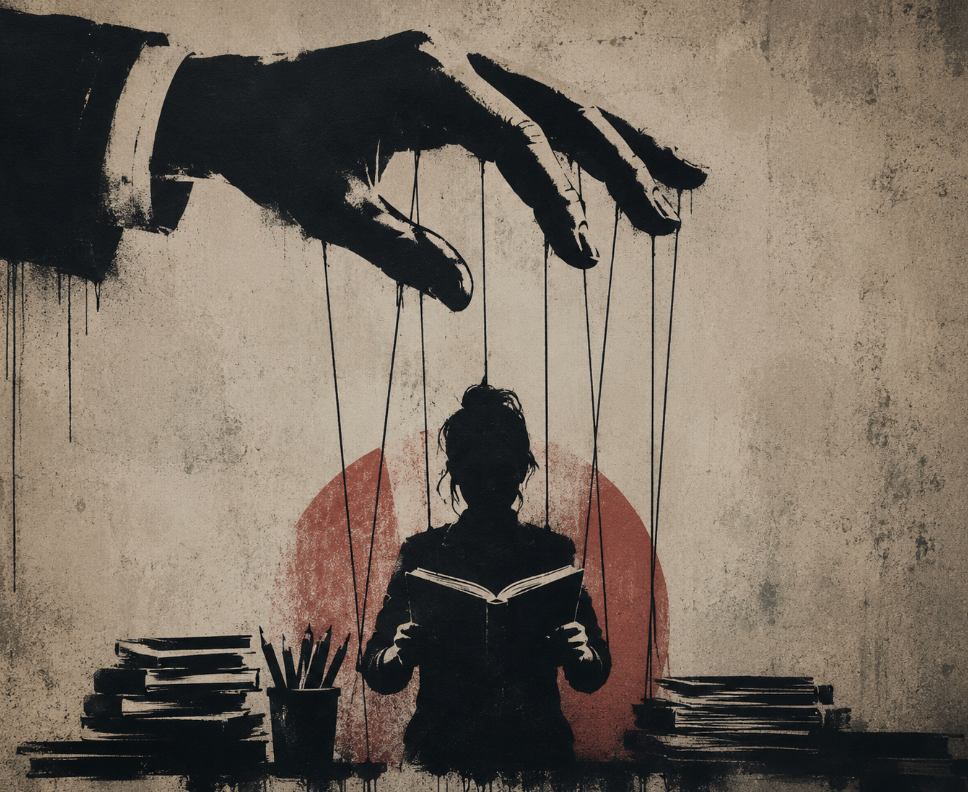
Benefield ultimately encountered an organisation in which many people were apparently frightened of doing precisely that.
The final review records deeply held concerns about speaking up and fears about career consequences. A majority of participants said they didn't feel able to speak up. People described concerns about job security, progression, being removed from work and what might happen if they challenged decisions or provided unwelcome advice. And despite 107 people participating in the review, nobody consented to having their individual concerns formally referred for investigation. The review itself tells us that fear was one of the reasons people were reluctant to take matters further.
That is an extraordinary problem for any organisation trying to understand what has gone wrong inside itself.
But I've realised there is another question sitting underneath all of this.
What were they so frightened of speaking up about?
What weren't people “going along with”?
Benefield did not conclude that 107 people were secretly opposing the Government's curriculum reforms. In fact, her review makes the opposite point in places. Many participants understood perfectly well that public servants are required to serve the government of the day. But that wasn't quite what many of them said the problem was.
People described wanting explanations for instructions they were receiving. They wanted clarity about where instructions had come from. Some apparently couldn't tell whether a direction represented a decision of Ministry leadership or something coming from the Minister's office. People questioned whether the timeframes they were being asked to deliver were realistic. There were concerns about whether free and frank advice was reaching the Minister.
That is different from refusing to implement Government policy. There is a difference between saying: “I refuse to do what the Government has decided.” and saying: “Can somebody explain why we are doing this, who instructed us to do it, whether we have properly advised the Minister of the risks, and could you please put that instruction in writing?”
Then the whistleblowers arrived.
Days ago, New Zealanders saw footage of Dr Catherine Law telling Ministry curriculum staff not to record particular information in writing because it was “OIA-able”. That particular conversation isn't something being reconstructed months later from someone's memory. We can see and hear what Law said, it is pretty much a fact.
Whistleblowers have since alleged that this wasn't an isolated event. They have described occasions where contentious instructions were given verbally, where requests to have instructions confirmed in writing were allegedly refused, and where criticism being recorded during curriculum discussions was allegedly stopped with reference to the OIA.
One whistleblower has gone further, alleging repeated verbal instructions relating to curriculum content, including the removal of particular Māori terminology. It makes me wonder whether we are beginning to get a glimpse of what at least some people inside Te Poutāhū may have been struggling with.
How do you investigate something that leaves no paper trail?
Benefield was allowed access to Ministry policies, procedures, documentation, data, records and reporting relevant to her review. Great. Except what happens if the thing you're trying to understand isn't in the records? What happens if an important instruction happened in a Teams call? In a corridor? After a meeting? Over the phone?
What happens if somebody asks for that instruction in writing and, as whistleblowers now allege happened on some occasions, the person giving it refuses? And what happens if the employee receiving that instruction already works within a culture where challenging leadership feels dangerous?
This is where the Benefield findings and the subsequent whistleblower allegations become difficult for me to separate. Together they describe conditions in which establishing what actually happened could become extraordinarily difficult. Fear can silence witnesses.
And then I find myself wondering: if you already fear the consequences of speaking up, how much more frightening must a formal investigation feel when you aren't even sure there is a paper trail to support what you say happened?
And then somebody takes the extraordinary risk of capturing one of these conversations. Whatever ultimately emerges about the wider allegations, somebody inside this organisation apparently felt the need to preserve a record of what was being said. In the culture Benefield describes, I keep wondering what it took to make that decision. It would have been quite terrifying.
Benefield did find lots of things. She found widespread concern about favouritism. Concerns about conflicts of interest and public-service principles. Concerns about speaking up. And concerns about whether the obligation to provide free and frank advice was being met. She found enough smoke to describe a workplace with serious cultural problems.
What she couldn't do under her Terms of Reference was turn many of those accounts into findings of individual wrongdoing. So instead of asking why Benefield couldn't prove particular allegations, perhaps we should be asking: Given the culture Benefield discovered, how possible was it ever going to be for her to prove them?
And now I have another question.
Would she have approached that task differently if the whistleblowers had spoken before her review rather than after it?
The Chief Ombudsman is now conducting a formal investigation into allegations of attempts to circumvent the Official Information Act. He says the investigation will be completed as soon as possible, but speed will not come at the expense of thoroughness. Good. Because I hope this investigation goes considerably deeper than searching Ministry inboxes for an email entitled: “Things We Don't Want OIA'd.docx”
If the allegation is that information was deliberately not being recorded, searching only the records would be crazy. Understanding what happened may require reconstructing events from people as well as paper. The allegation isn't simply that somebody mishandled an OIA request. It is potentially that, on some occasions, information wasn't being created in the first place because somebody was thinking about what might happen if somebody requested it.
The Chief Ombudsman himself has said public trust and confidence in both the Ministry and the OIA would be undermined if these allegations were found to be true.
In an entirely separate investigation published this month, the Ombudsman's office made an observation that suddenly feels rather important. An organisation's culture around transparency and openness flows from the attitudes, messaging and actions of its senior leaders — particularly its chief executive.
That raises another uncomfortable set of questions for me about Secretary for Education Ellen MacGregor-Reid. How much did the chief executive know about the culture Benefield ultimately uncovered? When did she know it? What concerns had reached senior leadership before Benefield was commissioned? And if an organisation can develop this degree of fear without its chief executive appreciating its extent, what does that tell us about the organisation's own mechanisms for surfacing bad news?
They seem like reasonable questions to ask.
This is the Ministry of Education.
This is a question now for Ainsley Benefield.
I want to know whether what has happened since has changed how she reads her own findings. I would like somebody to sit down with her and ask: Knowing what you know now — having seen the recording and heard the subsequent allegations about verbal instructions and avoidance of written records — would you have conducted your review differently? Do you still believe the original Terms of Reference were sufficient for the organisation you discovered?
I don't know what Benefield would say.
Maybe someone could ask her?


Comments